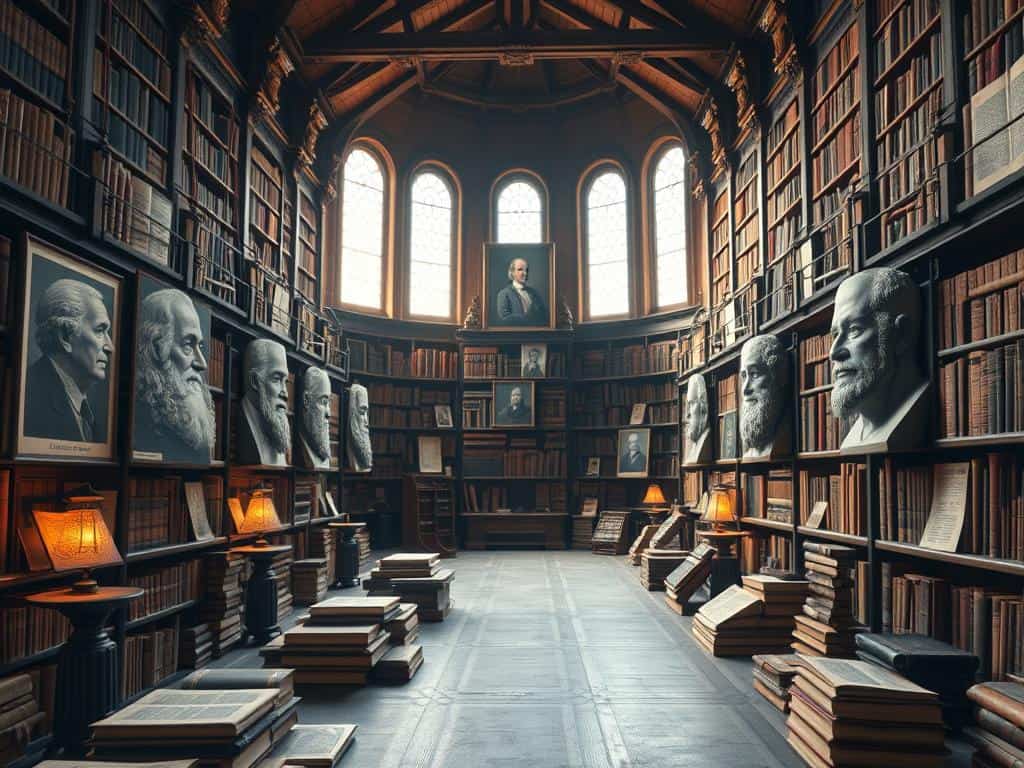
In a busy café, I heard a heated discussion between two friends. One was talking about the need for personal freedom, citing famous philosophers. The other was worried about the bigger picture, like how we all fit together. This conversation made me realize how much philosophers’ thoughts influence us today.
Their ideas, from long ago, are all around us. They guide our talks and decisions in politics, ethics, and even our personal lives. Let’s dive into the legacies of these thinkers. We’ll see how their work affects our world and tackles today’s big questions.
Key Takeaways
- Philosophy plays a key role in understanding human life.
- Many great philosophers have influenced each other’s ideas.
- Ancient Greek philosophy is very relevant today.
- Thinkers like Aristotle and Confucius focused on ethics and morality.
- Important debates in philosophy cover rights, freedom, and our duties to society.
- The wisdom of these thinkers is important in many areas, including politics and psychology.
What is Philosophy and Its Relevance Today
Philosophy comes from the Greek word for “love of wisdom.” It explores big questions about knowledge, existence, and reality. For thousands of years, philosophers have worked in areas like ethics, metaphysics, and epistemology. Today, philosophy helps us understand ourselves and the world, promoting critical thinking and self-reflection.
Definition and Origins of Philosophy
Philosophy is more than just studying; it’s a journey to understand reality and our role in it. Ancient thinkers like Socrates started asking big questions about life. They talked about morality, happiness, and what makes a life good.
Later, thinkers like Aristotle explored what it means to be human and how to live well. Their ideas show how philosophy is always relevant, helping us make sense of ethics and values.
The Role of Philosophy in Understanding Human Existence
Philosophy helps us grasp human existence. It asks tough questions about morality and how we make choices. Modern thinkers like Albert Camus look at life’s meaning in today’s world.
Philosophy teaches us to think critically, solve problems, and communicate well. These skills are valuable in many careers, like law, education, and business. As technology advances, philosophy’s focus on ethics is more important than ever.

Great Philosophers and Their Enduring Legacies
Great philosophers have shaped thought for centuries. Their ideas on ethics, democracy, and morality are key. Let’s look at some of these thinkers and their lasting impacts.
Aristotle: The Father of Logic and Ethics
Aristotle was a giant in ancient philosophy. He wrote over 200 treatises, with 31 studied today. His work on ethics and politics helped us understand human behavior and governance.
Lao-Tzu: The Harmony of Taoism
Lao-Tzu taught us to live in harmony with nature. His ideas help us find balance between humans and the world. His teachings guide us towards spiritual growth and understanding natural laws.
John Locke: The Foundation of Liberal Democracy
John Locke changed political thought with his views on rights and government. His ideas shaped modern democracy, influencing the U.S. Constitution.
Karl Marx: Against Capitalism’s Inequities
Karl Marx exposed capitalism’s flaws and class struggles. His work challenges wealth distribution and sparks debates on inequality. His insights are relevant today, as we discuss capitalism’s effects.
Confucius: The Importance of Moral Standards
Confucius stressed the value of ethics and moral character. His teachings shape society and education, showing the power of ethics in building community values.
Ralph Waldo Emerson: The Call for Individual Judgment
Emerson believed in self-reliance and intuition. His ideas on human growth inspire self-empowerment and value exploration. His legacy encourages us to understand our values within society.
Immanuel Kant: Duty as the Basis of Morality
Kant’s philosophy focuses on duty and the categorical imperative. His work is key in ethics and moral reasoning. It helps us understand how ethics align with society and personal responsibility.
Epicurus: Happiness through Pleasure
Epicurus believed happiness is the ultimate goal. He said pleasure comes from simplicity and avoiding pain. His views on happiness influence our understanding of well-being today.
Socrates: The Importance of Knowledge
Socrates was a pioneer in philosophy. He used the Socratic Method to seek knowledge and virtue. His approach to learning and ethics is foundational in Western thought.
Friedrich Nietzsche: Challenging Meaning and Morality
Nietzsche questioned traditional morals and values. His ideas make us think about meaning, beliefs, and morality. He challenges us to question established values.

Conclusion
The ideas of great philosophers have greatly shaped our modern views on ethics, governance, and existence. They have asked deep questions that make us think and learn. Their teachings continue to influence us today.
By looking at their work, I see new ways to think about big issues. For example, the *Repugnant Conclusion* in population ethics. Philosophers like Parfit have raised important questions about this.
Philosophical debates deeply affect our lives. They help us understand complex issues like populational ethics and the Non-Identity Problem. These debates show the complexity of moral philosophy.
Even when we find contradictions, like in Kant’s Categorical Imperative, we must think deeply. We must consider our moral duties and the effects of our choices.
In the end, philosophy’s strength is in questioning and sparking deep conversations. The work of great thinkers helps us understand life and our role in it. Philosophy is not just old ideas; it’s a key part of our ongoing intellectual journey.